

Smithsonian Science for the Classroom™ is a hands-on science program that brings highly engaging 3D learning and 3D assessment to K–5 classrooms.
Developed by the Smithsonian Science Education Center (SSEC), Smithsonian Science for the Classroom modules:
Yes! With module titles like How Can Animals Use Their Senses to Communicate? and How Can We Provide Freshwater to Those in Need? it’s evident that students are engaging directly with exciting, real-world phenomena and solving real-world problems. Smithsonian Science for the Classroom was developed to meet the three dimensions of NGSS.
A complete 3D assessment system is integrated directly into the investigations. The lessons within Smithsonian Science for the Classroom were developed to provide 3D assessments as part of the investigations that students are already doing, not as separate tasks that need to be added on to instruction and take additional time.
The 3D assessment system includes:
Science, literacy, and math are natural partners. By using Smithsonian Science for the Classroom, teachers can efficiently prepare students to meet science, math, and English language arts (ELA) standards.
Each module integrates Smithsonian Science Stories literacy readers and student-created STEM notebooks.
Reading selections from literacy readers are incorporated into the main activities of many of the lessons in each module. These culturally relevant and historically accurate readers incorporate research and artifacts that only the Smithsonian can provide.
Smithsonian Science Stories are available in a variety of formats:
Smithsonian Science Stories reading levels are carefully calibrated to grade level–appropriate Lexile measurements according to text complexity guidelines.
Student-created STEM notebooks provide a space for students to record and organize their design and testing plans, collected data, ideas and explanations of phenomena, evaluations of design solutions, and more.
Hands-on investigations engage students in standards-based math skills that relate to science content and science and engineering practices.
Common Core ELA and Math connections are highlighted in each Teacher Guide in the lesson planner and with the lessons at point-of-use.
Yes! The hands-on approach of Smithsonian Science for the Classroom naturally supports the diverse learning styles and abilities among students. The program provides teachers with tools to support these diverse needs and students with first-hand learning experiences.
Hands-on investigations offer students a variety of ways to demonstrate understanding through writing, drawing, and student discourse. This in turn offers teachers a variety of ways to monitor students’ progress and understanding.
The program’s instructional resources for teachers and students offer several ways to reach all students.
Throughout each module, relevant, research-based ELL strategies are embedded at point-of-use, in addition to student misconception support and remediation and enrichment strategies.
Functionality of resources was considered during development. Modules provide:
Digital literacy readers that allow for close reading strategies and text-to-speech capabilities.
Yes! Student resources are available in Spanish—both in print and digitally.
Spanish resources include:
Smithsonian Science for the Classroom thoughtfully and flexibly integrates digital resources that meaningfully enhance learning. Whether a classroom is 1-to-1 or has only one computer, you can fully teach this program.
Digital resources include:
Point-of-use Teacher Tips suggest modifications based on limited technology availability. Tech Tips suggest additional ways to incorporate technology into lessons or activities.
Yes. Carolina Science Online is compatible with most LMS.
Yes! There are two ways to preview the program. We offer a digital review of the complete program. If you would like to see more, we can arrange to have samples sent for your review or talk to you about setting up a pilot.
Yes! Carolina Biological Supply Company is committed to providing comprehensive, customized professional development to meet the needs of teachers, staff, and administrators. Carolina’s professional development provides multiple opportunities for all teachers to master the curriculum and implement best practices. Formats include hands-on workshops, webinars, and teacher resource videos. Learn more about Get Ready! Professional Learning
Spiral-bound teacher’s guides are found within the blue crate that has the item number in this format: XXXXXX-1. Teacher’s guides are typically found on the floor of the crate to avoid any warping.
Digital resources are accessed using a code sent via email when your kit is shipped. We often send the email to whoever placed the order, usually a purchaser at your school or district. If you cannot find the email, call our customer service team at 800.334.5551.
They will be able to locate the code and help you access your resources. If possible, have the order number or purchase order number available to help them locate your information quickly.
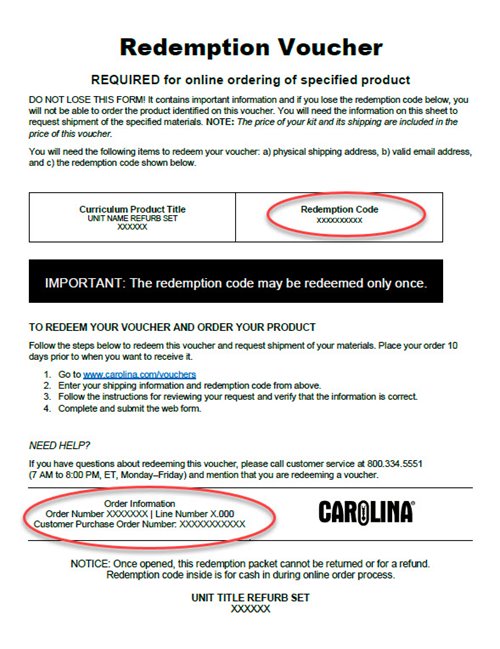
To redeem your voucher and request shipment of your materials, follow the steps below. Place your order 10 days prior to when you want to receive it.
1. Go to www.carolina.com/vouchers
2. Enter your shipping information and the redemption code(s) from your voucher(s).
3. Follow the remaining instructions to complete your request.
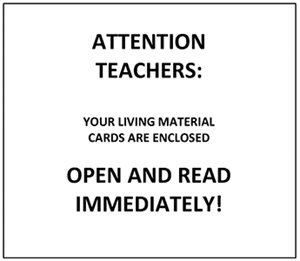
Your living materials sheets will be in a clear shipping envelope that looks like this that is adhered to the side of the blue tub of the kit if it is new or the side of the brown Carolina box if it is a refurbishment. (Remember to hang on to the 2 additional sheets/sheet sets if you’ve purchased a 3-Use kit or refurbishment.)
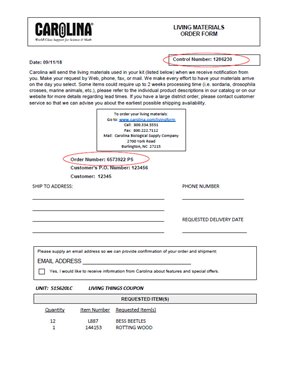
Living material sheets have a control number that can be used to order the live materials. Directions for ordering are on the sheet.
Call customer service at 800.334.5551 with your order number. They will be able to look up the living materials control number for your specific order.
Care guide information for units that have living materials can be found in Tab 5 Materials Management and Safety section of the teacher’s edition. If you are using the digital teacher’s edition, this information can be found by clicking on the Module Title →selecting the Front Matter and Resources tile → Tab 5 Materials Management and Safety
Module materials that require and SDS are designated in the Materials List of the Teacher’s Edition with a dagger (†).
Chemical components that require SDS information (components designated in the Materials List of the Teacher’s Guide with a dagger (†) are available at www.carolina.com/SDS.
Click here to view regional sales information and identify your region’s sales manager or contact us at curriculum@carolina.com.