How Smithsonian curriculum developers help K–5 students make sense of phenomena and problems

By Dr. Katya Jane Vines
Acting Division Director for Curriculum Development
Smithsonian Science Education Center
To shed light on the process, several Smithsonian Science Education Center (SSEC) curriculum developers offered insights into how they develop storylines for a grades K–5 curriculum that’s aligned to the Next Generation Science Standards* (NGSS). I spoke to several of my fellow curriculum developers to find out how they develop storylines for an NGSS-aligned K–5 curriculum. While no two developers work in exactly the same way, all developers agree that the process is not linear. Building a coherent storyline is like a complex engineering design problem: the steps are iterative, and the storyline is revised until the final picture becomes clear to all.
Taking Apart and Putting Back Together
The Glue That Holds the Pieces Together

Students collect evidence from a text to help them explain how a silver necklace is made starting with wax.
Making Sense of Phenomena and Problems
REFERENCES
Achieve. June 2016. The Next Generation Science Standards, For States, By States. “Bundling the NGSS.” Accessed August 2020: https://www.nextgenscience. org/resources/bundling-ngss
Educators Evaluating the Quality of Instructional Products. September 2016. “EQuIP Rubric for Lessons & Units: Science.” Version 3.0. Accessed August 2020: https://www.nextgenscience.org/sites/default/files/ EQuIP%20Rubric%20for%20Science%20v3.pdf
Kurin, R. December 17, 2014. Smithsonian Magazine. “For Every Object, There Is a Story to Tell.” Retrieved August 2020: https://www.smithsonianmag.com/ smithsonian-institution/for-every-object-there-is-storyto-tell-180953589/
Krajcik, J. S., S. Codere, C. Dahsah, R. Bayer, and K. Mun. 2014. “Planning Instruction to Meet the Intent of the Next Generation Science Standards.” Journal of Science Teacher Education 25(2): 157–175.https:// www.tandfonline.com/doi/full/10.1007/s10972-014- 9383-2
Odden, B., and R. Russ. January 2019. “Defining Sensemaking: Bringing Clarity to a Fragmented Theoretical Construct.” Science Education 103: 187– 205. https://onlinelibrary.wiley.com/doi/full/10.1002/ sce.21452
Penuel, W. R., and B. J. Reiser. 2018. “Designing NGSS‐Aligned Curriculum Materials.” Retrieved from paper prepared for the committee to revise America’s Lab Report, Washington, DC: National Academies Press: https://sites.nationalacademies.org/cs/groups/ dbassesite/documents/webpage/dbasse_189504.pdf
Penuel, W. R., K. Van Horne, J. Jacobs, T. Sumner, D. Watkins, and D. Quigley. 2017. “Developing NGSS-Aligned Curriculum that Connects to Students’ Interests and Experiences: Lessons Learned from a Co-Design Partnership.” Paper presented at NARST, San Antonio, Texas.
How Smithsonian Science for the Classroom Curriculum Supports Student Sensemaking of Phenomena and Problems
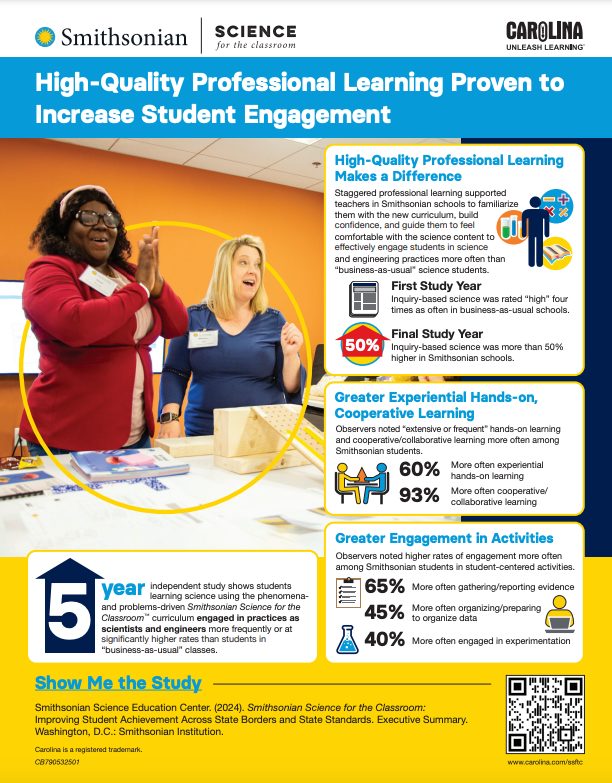
NGSS requires that students make sense of phenomena and problems using three dimensions. Smithsonian Science for the Classroom includes authentic phenomena and problems that draw on the rich resources of the Smithsonian as well as research and data from other scientific organizations. In each module, students actively engage in figuring out multiple phenomena and problems that will enable them to complete an end-of-module performance assessment. In figuring out these phenomena and problems, students gain in proficiency in using a small number of SEPs and CCCs that they will use in the end of module assessment.
Learn more about Smithsonian Science for the Classroom:
Carolina Biological Supply Company. www.carolina.com/ssftc
Email: curriculum@carolina.com
Call: 800.334.5551
©Smithsonian Science Education Center. Transforming K–12 Education through Science ™ in collaboration with communities across the globe ScienceEducation.si.edu